

LOUISVILLE, Ky. (KT) – Three studies released this fall analyzed the impact of abortion on mental health, provided preliminary data on the widespread effect abortion bans had on birth rates in the year following Roe v. Wade’s repeal and demonstrated an uptick in interstate travel to access abortion services.
Approximately 32,000 annual births resulted from abortion bans
A study conducted by the Institute of Labor Economics analyzed provisional birth rate data for the first half of 2023, providing first estimates of how the Dobbs v. Jackson Supreme Court decision—which undid abortion access rights protected for nearly a half century by Roe v. Wade—affected fertility.
Births rose by an average of 2.3% in states with total abortion bans, like Kentucky, compared to a control group of states where abortion access was protected, yielding an approximate total of 32,000 additional annual births.
While the effects varied across demographic groups, they tended to be larger for younger women and women of color. There was a percentage increase in births of 3.3%, 2.8% and 2% for women aged 20-24, 25-29 and 30-44, respectively. Teenagers aged 15-19 were an outlier group, demonstrating no evidence of increased birth rates.
Consistent with previous studies that indicate abortion restrictions impact the birth rates of non-white women most significantly, there were increases of 3%, 3.8% and 4.7% for non-Hispanic white, non-Hispanic Black and Hispanic women, respectively.
Travel distances to active abortion providers, exacerbated by state bans, impacted birth rates—the study found “states with the greatest increases in driving distance also tended to have the greatest estimated increases in births.”
Kentucky had a realized increase in births more than twice as large as the study originally forecasted. Researchers suggested limited appointment availability at the next nearest facility could have contributed to the surge in births: After Kentucky’s two Louisville-based abortion clinics closed, “the sole facility in southern Ohio that became the nearest destination for most Kentuckians had no available appointments within three weeks when contacted in September 2022 and none at all when contacted in December 2022.”
1-in-5 women travelled out of state to obtain abortions in the first half of 2023
New data from the Guttmacher Institute, a pro-abortion research and policy organization, show an uptick in women seeking abortions out of state. One in five women travelled across state lines to access abortion in the first six months of 2023, compared with one in 10 women during a similar period in 2020. That’s 92,100 women in 2023, up from 40,600 women in 2020.
The data, pulled from Guttmacher’s Monthly Abortion Provision Study, is the first comprehensive data measuring the extent of interstate travel for abortion since Roe’s reversal in June 2022.
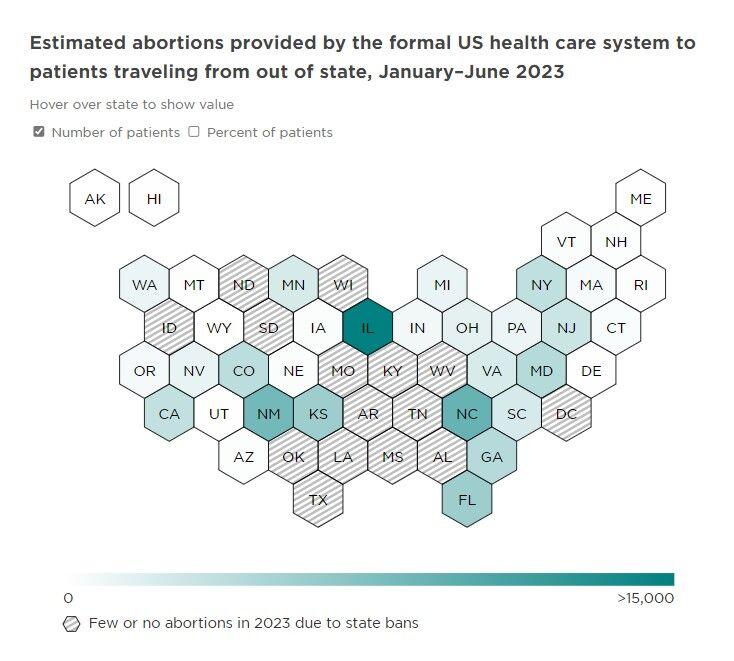
Illinois, which borders three states where abortion is illegal (including Kentucky), experienced the largest increase of patients traveling from out of state. Guttmacher classifies the state as “protective” of abortion access.
New Mexico, Colorado, Florida and Ohio also experienced a significant influx of non-resident women seeking abortions.
Guttmacher noted some protective states saw little or no increase in out-of-state patients, “likely because they border other protective states.” Fourteen states, and Washington D.C., are classified on a scale of “most protective” to “protective,” and the states which border each other are concentrated on the west coast and in the Northeast.
Post-abortion depression widespread globally
A systematic review and analysis of existing research found that depression after abortion is a common problem across the globe. The study, published in BMC Psychiatry, noted that the prevalence of post-abortion depression can be influenced by several factors, including the methodology and diagnostic tools utilized in a study, the geographical location being studied and the socioeconomic status of the population.
Worldwide, the study indicated 34.5% of women experienced depression after an abortion. While North America, South America and Antarctica were not included, the study found Asia exhibited the highest prevalence of post-abortion depression, followed by Europe, Africa and Australia, respectively.
Depression after abortion was most common in lower- and middle-income countries, compared to high-income countries.
The study concluded: “Individuals who have undergone an abortion should receive additional care and psychological support from healthcare providers, as well as their spouse, family, and community.”
 Friends of Life KY